
Every guide to Character.AI memory gives you a different number. The context window is “4,000 tokens” or “8,000” or “3,000”. It forgets after 15 messages, or 25, or 150. You can pin 5 memories, or 15. This is what the primary sources actually say — and why the most-repeated question has no answer.
Start with the cleanest example of the problem.
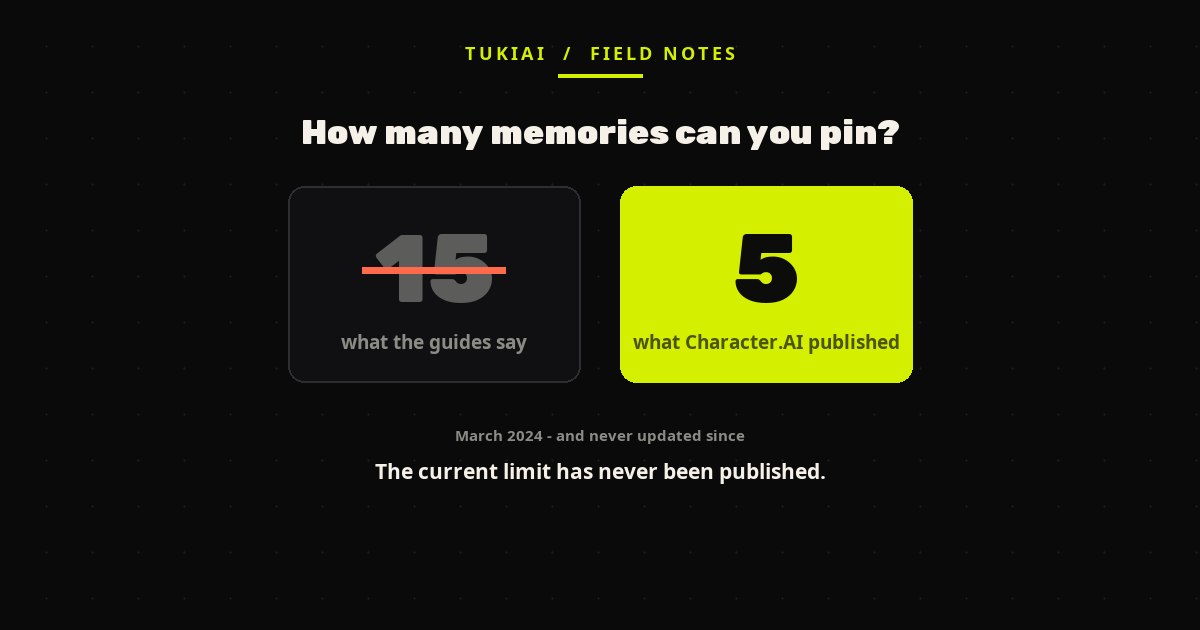
Two sites say you can pin 15 memories. Both link to the page that says 5.
Search for how many memories Character.AI lets you pin and you will find “up to 15” stated confidently. Two of the pages saying it — one published 30 April 2026, one on 22 May 2026 — hyperlink their claim directly to Character.AI’s own help-centre article on Pinned Memories.
That article says: “save and pin 5 messages in each chat.” It was published on 30 March 2024 and, according to the help centre’s own edit history, has never been edited since.
Nobody checked the link. And that single habit explains almost every number you will read about Character.AI memory, including the ones in the paragraph you just read.
I will resolve the pin question properly at the end, because the honest answer is more interesting than either number.
The Character.AI memory limit, in one table
Every number below traces to a Character.AI page or post, with its date. Where the company has published nothing, the row says so rather than guessing.
| Figure | What it governs | Source and date | Status |
|---|---|---|---|
| Never published | Context window, in tokens or in messages | — | No official figure has ever existed |
| 5 | Pinned memories per chat | Help centre, 30 Mar 2024 | Official, and never edited since — see below |
| "twice as many" | Pins for c.ai+ over the base tier | Memory post, 21 May 2026 | Official, but the base it doubles is unpublished |
| 40 messages | Before automatic memories first appear | Community Update, 29 Apr 2025 | Official — the only message-count figure that is |
| 180 messages | Average dialogue history carried per message | Inference post, Jun 2024 | Official, platform-wide average |
| 32,000 characters | Character Definition | Help centre and creator docs | Official, no subscription-tier split stated |
| 4,096 characters | Greeting | Help centre, Apr 2025 | Official — creator docs disagree; this is the current one |
| 2,250 characters | Persona | Feb 2025 | Official, not restated since |
| 1,000 chats | Chat history retained per Character | Dec 2025, raised from 100 | Official — archive depth, not context |
| "4x the Memory" | LongSqueak chat style, c.ai+ only | @character_ai, 5 Aug 2026 | Official, but relative — four times an unstated number |
| 15 pins | Nothing — the figure does not exist | Circulates widely | Unsourced. Pages stating it link to the page that says 5 |
That is the entire published record. If a number you have read is not in this table, no Character.AI document contains it.
Character.AI has never published a context window — and the question is malformed
This is the finding that reframes everything: Character.AI has never published a context-window size in tokens. Not on the blog, not in the help centre, not in the creator documentation. Every token figure in circulation is somebody’s estimate, and most are presented without any source at all.
But the deeper problem is that “what is Character.AI’s context window” assumes an architecture Character.AI does not use.
In its engineering post Inside Kaiju (7 November 2025), the company describes its production models — 13B, 34B and 110B parameters — like this: “All Character.ai models interleave sliding window and global attention layers. For current production models, this is done in a roughly 5:1 ratio of sliding to global attention, and the sliding window is 1024 tokens long.”
An earlier post, Optimizing AI Inference at Character.AI (20 June 2024), says the same thing from the other direction: reducing the attention horizon to 1024 on most layers did not significantly hurt evaluation metrics, and “only 1 out of every 6 layers uses global attention.”
So five of every six layers in the model see a 1,024-token window. There is no single flat number that describes what the model can hold, which is exactly why fifteen different blogs can each produce a different one and none can be checked.
One trap worth naming, because it is where at least some of the “128K” claims come from: Character.AI’s Prompt Poet documentation contains the line TOKEN_LIMIT = 128000. It sits inside a generic code example that calls ChatOpenAI(model="gpt-4o-mini"). It is a library demo, not Character.AI’s production limit.
How the forgetting actually happens: in steps, not as a fade
Character.AI open-sourced the tool that assembles its prompts. Introducing Prompt Poet (14 August 2024) is the most useful public document about Character.AI memory that exists, and almost nobody writing about memory has read it.
Two lines matter. First, what goes into the prompt: “current conversation modalities, ongoing experiments, the Characters involved, chat types, various user attributes, pinned memories, user personas, the entire conversation history and more.” Your Persona, the Definition and your pins are not stored somewhere separate — they compete for the same space as your chat history.
Second, how it cuts: “Context length is limited and can’t always fit the entire chat history — so we can set a truncation priority on the message parts and Prompt Poet will truncate these parts in the order in which they appear (oldest to newest).” And critically: “every time we truncate we do so up to a fixed truncation point — only moving this truncation point on average every k turns.”
That is why forgetting feels like a cliff rather than a slope. The truncation point holds still for several turns, then jumps, and a block of your early conversation disappears at once. Users describe this as the bot “suddenly” forgetting. It is not sudden — it is discrete, and it is by design, because holding the truncation point still is what lets the prompt stay in cache. The same 2024 post reports a 95% cache rate serving over 20,000 inference queries per second.
The Definition truncates the same way. Character.AI’s own creator guide says “the AI reads top to bottom, so what comes first matters most … The further down something sits in the Definition, the less reliably it shapes your Character’s behavior.”
The vocabulary changed in May 2026, and most guides never noticed
If an article tells you to use “Pinned Memories” and the “Chat Memories” box, it is describing a product that no longer exists under those names.
Between 24 April and 11 May 2026, Character.AI shipped a rebuilt memory system, announced across a six-part series on X and consolidated in the blog post Smarter Memory for Smarter Chats (21 May 2026). The current vocabulary:
- Memory — the whole system, on its own screen, reached by the notebook icon in the chat header.
- Story Memory — a free-form field for backstory and events, and the destination for pins. Available to everyone.
- Pin to Memory — long-press a message and tap Pin to lock it into Story Memory.
- Facts — automatically captured details, with separate tabs for your Persona, the Character, and side characters you mention. c.ai+ only.
- Memory Usage — a bar showing what is filling the chat. Free users get a simple version; the full visualisation is c.ai+.
- Auto-Compact — background compression of older chat.
- Copy Memory — carry Story Memory and Facts into a new chat.
- Lorebook — keyword-triggered world entries, up to 8 keywords per entry, launched 24 July 2026 in c.ai+ beta.
The dead names, for translation: “Pinned Memories” (March 2024), “Chat Memories” (the 400-character box, May 2025), and “Auto Memories” (March 2025, now Facts).
There is a genuine oddity here. As of 9 August 2026, Character.AI’s help centre contains no article at all documenting Story Memory, Facts, Memory Usage, Auto-Compact or Copy Memory. Its creator guide, edited 17 June 2026 — a month after launch — still describes pinned messages, a 400-character Chat Memories field and auto-memories. And its 2023 article “Why do Characters forget things?”, never edited since 2 May 2023, still tells readers “We are working on extending this context.”
So when third-party guides are out of date, they are frequently copying Character.AI’s own out-of-date pages faithfully.
Every official Character.AI memory number that exists
The table above is the summary; this is the provenance behind each row, with what the source actually says. Short list, because it is a short list.
- 40 messages — how many you need to send before your first automatic memories appear. Community Update, 29 April 2025. This is the only official message-count figure ever published.
- 180 messages — the average dialogue history per message on the platform, from the June 2024 inference post. Worth holding next to the blogs claiming the bot forgets everything by message 15.
- 32,000 characters — Character Definition limit, stated in both the help centre and the creator documentation. No subscription tier split is stated anywhere.
- 2,250 characters — Persona limit, February 2025. Not restated since, and the creator docs list no limit at all.
- 4,096 characters — Greeting limit, April 2025.
- 1,000 chats — chat history retained per Character, raised from 100 in December 2025. This is archive depth, not context.
- "4x the Memory" — claimed for LongSqueak, the chat style announced on 5 August 2026 for c.ai+ members, which Character.AI says “can make better use of Lorebooks, Facts, and Character Definitions as it writes.” It is the newest official memory statement on record, and also the clearest illustration of the problem this article describes: a multiplier with no published baseline.
- 5 pins — March 2024, never updated.
Notice what is absent: no token count, no message count for forgetting, no current pin number, and no absolute memory figure attached to c.ai+ ($9.99/month) beyond the words “Better memory” and, since August 2026, a multiplier with no baseline. There is no published Character.AI memory limit in tokens. There never has been.
Two of Character.AI’s own properties even disagree with each other: the creator documentation site lists the Greeting limit as 0–500 characters, while the help centre says 4,096. The 4,096 figure is the current one.
What actually makes it remember
Everything below is mechanism-based rather than folklore, and each follows from a documented behaviour above.
- Pin, because pins are protected. This is the strongest guarantee Character.AI publishes. From the May 2026 memory post: “Anything you’ve written into Story Memory or pinned yourself is protected. It stays put no matter how full the bar gets.” Auto-Compact will compress your chat history; it will not touch Story Memory.
- Front-load the Definition. Since the model reads top to bottom and the tail truncates first, anything that must always be true belongs in the first lines, not the last.
- Restate, don’t rely. Because truncation runs oldest-to-newest, a detail established at message 3 and never mentioned again is the first thing to go. Mentioning it again moves it back into recent history.
- Expect the jump. The truncation point moves roughly every k turns, so quality degrades in steps. If a Character just lost the plot, that is the moment to pin what matters — not twenty messages later.
- Use Lorebook for the long tail. Character.AI’s framing when it launched: “Until now, everything a Character knew about its world had to fit inside its definition… With Lorebook, that tradeoff is gone: the lore stays out of the way until the story calls for it.” Keyword-triggered entries do not consume space until they fire.
- Watch the Memory Usage bar rather than counting messages. It is the only instrument Character.AI gives you, and it measures the thing that actually matters.
What nobody can tell you, including me
Three things I could not establish, stated plainly rather than filled in.
The current pin limit is unpublished. Here is the resolution I promised. The only official figure is 5, from March 2024. The May 2026 post says c.ai+ subscribers get “twice as many pins” — which means a current base number exists and Character.AI has not published it. So “5” is stale, “15” is invented, and the true answer is only obtainable by opening the app and counting. Anyone who states it with confidence and no screenshot is guessing.
The second gap: no independent, replicated measurement of when forgetting starts exists. The spread across guides published in the same quarter of 2026 runs from 10 messages to 150 message pairs — a twentyfold range for one platform. The closest thing to real evidence is a hands-on test published 14 May 2026 by DreamGen, which planted details early in three roleplays and found them recalled at 30 and 35 messages. DreamGen sells a competing product, and the result runs against its own commercial interest, which is the main reason I mention it.
Third: whether Lorebook is a retrieval-augmented pipeline. Several sites assert it. Character.AI describes keyword-triggered entry injection, which is not the same claim — I went through how Lorebook actually works, and what changed in August separately.
Why a shop owner wrote this
I build an AI sales agent for WooCommerce stores, which means I spend my working life on the same problem in a less forgiving setting. When a roleplay Character forgets your eye colour, it breaks the story. When a shop assistant forgets which product you were discussing, or answers from a snapshot of the catalogue taken last Tuesday, it quotes a wrong price to a paying customer.
The mechanics are identical: a finite context, a truncation order, and a decision about what is protected from it. The reason I read Character.AI’s engineering posts is that they are unusually candid about the trade-off — which is also why it is disappointing that the user-facing numbers are so thoroughly undocumented.
If you want the commercial version of this, I wrote about the six questions that break a store’s AI agent and what an AI chatbot for WooCommerce actually costs, both with dated figures. And if you came here from the chat styles side of Character.AI, that guide is here and covers what survived the 2026 purge.
How this guide stays honest
Every number above is either quoted from a Character.AI page with its publication date, or explicitly labelled as unpublished. Where the company contradicts itself, both versions are shown. Nothing here is an estimate presented as a measurement, and where a figure could only be obtained by opening the app, I have said so instead of inventing one.
Character.AI stopped publishing monthly Community Updates after December 2025, so the documentation gap is likely to widen rather than close. If a number here goes stale, the dates are provided so you can check it yourself — which is more than the pages claiming fifteen pins ever offered.
Sources
- Character.AI — Inside Kaiju: Building Conversational Models at Scale, 7 November 2025 (model sizes, 5:1 sliding-to-global attention, 1,024-token window).
- Character.AI — Optimizing AI Inference at Character.AI, 20 June 2024 (1-in-6 global layers, 180-message average dialogue history, 95% cache rate, 20,000 queries/second).
- Character.AI — Introducing Prompt Poet, 14 August 2024 (prompt composition, oldest-to-newest truncation, fixed truncation point).
- Character.AI — Smarter Memory for Smarter Chats, 21 May 2026 (Story Memory, Facts, Memory Usage, Auto-Compact, protection guarantee).
- Character.AI — Lorebook, 24 July 2026; Lorebooks help article, July 2026 (8 keywords per entry).
- Character.AI Help Centre — New Feature: Pinned Memories, 30 March 2024 (5 pins).
- Character.AI Help Centre — Why do Characters forget things?, 2 May 2023.
- Character.AI Community Updates — February 2025 (Persona 2,250), April 2025 (40 messages, Greeting 4,096), May 2025 (Chat Memories 400 characters), December 2025 (chat history 100 → 1,000).
- Character.AI Creator Guide — Character Definition (0–32,000 characters), 2026.
- DreamGen — Character.AI review with a hands-on recall test, 14 May 2026. Competing vendor; labelled as such.