
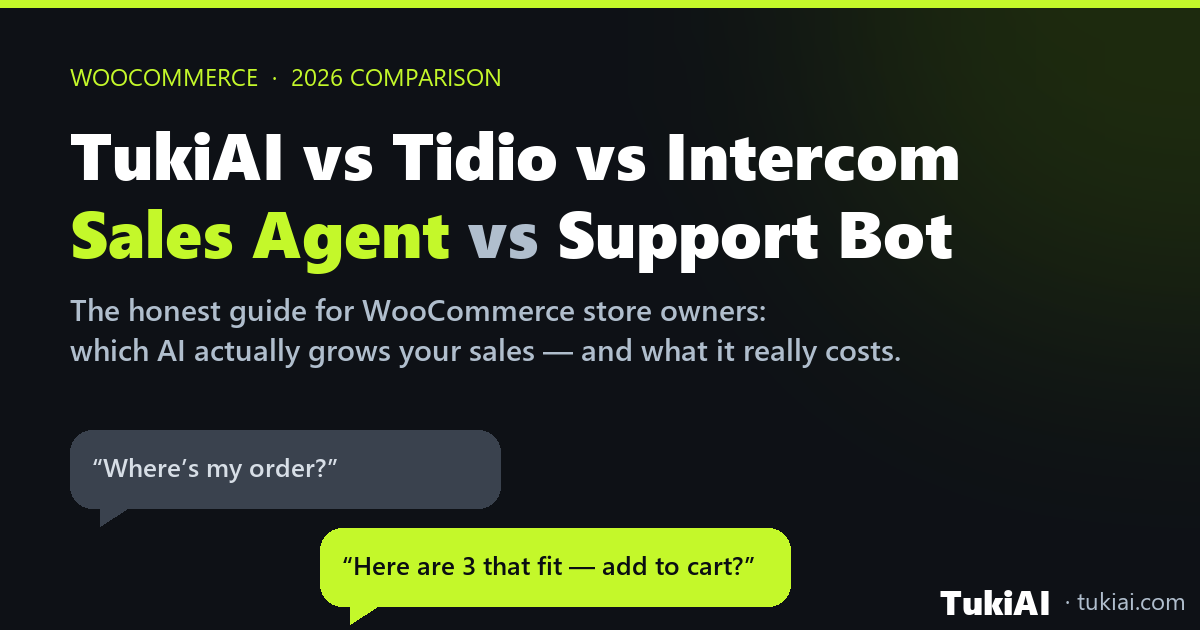
The honest answer depends on one question — do you want to spend less on support, or make more sales? Most comparison articles blur that line. This one won’t.
If you run a WooCommerce store and you’ve started shopping for an AI chatbot for WooCommerce, you’ve probably landed on Tidio, Intercom, and a handful of newer tools like TukiAI. On the surface they look interchangeable: a chat bubble, some AI, a promise to “automate conversations.” They are not interchangeable. They were built to do two fundamentally different jobs, and picking the wrong one is an expensive mistake you’ll feel every month on your invoice.
Let’s make the decision simple, honest, and specific to a store owner — not an enterprise support director.
First, the distinction nobody tells you
There are two categories hiding under the word “chatbot”:
1. AI support agents — their job is to deflect tickets. A customer asks “where’s my order?” or “what’s your return policy?”, and the AI answers so a human doesn’t have to. Success is measured in resolution rate — the percentage of questions handled without a person. Tidio (Lyro) and Intercom (Fin) are the best-known tools in this category. They are genuinely good at it.
2. AI sales agents — their job is to turn conversations into orders. A customer says “I’m looking for a laptop for work,” and the AI asks the right follow-ups, recommends specific in-stock products from your catalog, handles the objection, and walks them to checkout. Success is measured in revenue. TukiAI was built for this.
A support agent that occasionally suggests a product is not the same as a sales agent that occasionally answers a support question — any more than a receptionist is a salesperson. Both are valuable. They are not the same hire.
So before comparing features, answer this: What’s the bottleneck in your store — too many support tickets, or not enough sales? That answer, more than any feature table, tells you which tool to buy.
The 60-second comparison
| TukiAI | Tidio (Lyro) | Intercom (Fin) | |
|---|---|---|---|
| Built to | Sell (close orders) | Support (deflect tickets) | Support (enterprise) |
| Knows your catalog | Reads your live WooCommerce products, stock & prices | Trains mainly on FAQ / knowledge-base content, not the product DB directly | FAQ / help-content driven |
| Recommends products | Core function — specific in-stock items with prices & add-to-cart in chat | Can suggest products as a feature | Product recommendations as a resolution type |
| Channels | Website + WhatsApp + Instagram + Messenger, one inbox | Website + email + Messenger + Instagram + WhatsApp | Mostly Intercom Messenger / helpdesk |
| In-chat order actions | Yes — change address/phone, add notes, merge orders | Order status via flows | Support-oriented |
| Pricing model | Free pilot, then pay-per-sale or flat monthly | Add-on per AI conversation ($39–$289/mo on top of base) | $0.99 per resolution (min 50/mo) |
| Hebrew / RTL | Native, right-to-left first | English-first | English-first |
| Best for | Stores that want the AI to grow revenue | Stores that want to cut support load | Larger teams with heavy support volume |
Facts on Tidio and Intercom reflect their publicly published 2026 plans; features change, so verify current details on their sites.
 When Tidio is the right choice
Give Tidio real credit: Lyro is a strong AI support agent. If your inbox is flooded with “where’s my order,” “do you ship to X,” and “how do returns work,” Lyro will quietly handle a large chunk of it. You point it at your FAQ and policy pages, it learns the rules, and it replies across the web widget, email, Messenger, Instagram, and WhatsApp. For a store drowning in repetitive questions, that’s genuine relief.
The catch is the meter — and the math. Lyro is a separate add-on billed per AI conversation on top of your base Tidio plan, from about $39/month for 50 conversations up to $289/month for 500. A store with just 20–30 people a day asking questions can burn through 500 conversations in weeks. Worse, Tidio automatically bumps you to a higher tier when you hit ~95% of your quota — often with only an in-app banner, no email warning. Independent reviews describe $29 base plans quietly climbing past $200/month once the AI and automation meters stack up. And because real-world resolution rates usually land around 40–60%, you’re paying per conversation whether or not the AI actually resolved it.
Choose Tidio if: your #1 pain is support volume, you have the FAQ content to feed it, and you’re comfortable watching the conversation meter.
 When Intercom is the right choice
Intercom (its AI agent is called Fin) is the enterprise end of this market — polished, powerful, and priced accordingly. Fin charges $0.99 per resolution, with a minimum of 50 resolutions a month, and real-world resolution rates that land around 42–50%. It’s a serious platform for serious support operations — serious enough that in 2026 Salesforce agreed to acquire the company for roughly $3.6 billion.
But that’s exactly the point: Intercom is built for support teams at scale, not for a WooCommerce owner who wants more sales. The per-resolution pricing is transparent, but it’s still paying to answer questions, not to close orders. For most independent and mid-size WooCommerce stores, it’s more platform — and more cost — than the job requires.
Choose Intercom if: you’re a larger operation with a dedicated support team and high ticket volume, and support quality at scale matters more than the price tag.
When TukiAI is the right choice
Here’s the honest pitch, stated plainly: if you want the AI to make you money rather than just save you time, TukiAI is built for that job and the others aren’t.
The difference shows up in three places that matter to a store owner:
1. It actually sells. TukiAI reads your live WooCommerce catalog — products, categories, stock, prices — and behaves like a good salesperson. Ask it “I need a laptop for work and study” and it asks what matters to you, narrows the budget, and recommends specific in-stock models with prices and an add-to-cart button, right inside the chat. It spots when a shopper is hesitating and re-engages them with a well-timed offer. That’s a different design goal than a support bot that scrapes your FAQ page.
2. You pay for results, not for chatter. Tidio bills per conversation; Intercom bills per resolution. Both charge you whether or not a sale happened. TukiAI starts with a free pilot (no credit card) and then works on pay-per-sale or a flat monthly plan — pricing aligned with the outcome you actually care about. If a conversation doesn’t turn into revenue, it didn’t cost you a “conversation credit.”
3. It fits real stores — including yours. One agent covers your website, WhatsApp, Instagram, and Messenger from a single inbox. Customers can manage existing orders inside the chat — update an address or phone number, add a note, merge orders to save on shipping — without opening a support ticket. It’s native in Hebrew with full right-to-left support (a genuine gap in the English-first tools), it’s an authorized Meta tech provider for the WhatsApp Business API, and it automatically picks the best of several leading AI engines for each task.
Choose TukiAI if: your goal is to convert more of the traffic you already have — to have the AI recommend, persuade, and close — especially if you sell in Hebrew or across WhatsApp and social.
The decision, in one line
- Buried in support tickets? Tidio (or Intercom if you’re large) will lighten the load.
- Want more sales from the visitors you already have? That’s a sales agent’s job — start a free TukiAI pilot and let it prove it on your own store before you pay a cent.
The best way to know which tool fits isn’t a feature table — it’s your own numbers. Pick the one built for the problem you actually have.
Reading in Hebrew? קראו את ההשוואה בעברית.
Sources: Tidio pricing and Intercom pricing details are drawn from their 2026 public documentation and independent reviews. Vendor plans change frequently — confirm current pricing on each provider’s site.
Related: the 90-second demo test I now run against every one of these tools before comparing anything else.
Also: what these tools actually cost at 1,000 conversations a month — the list prices here are not the whole bill.