
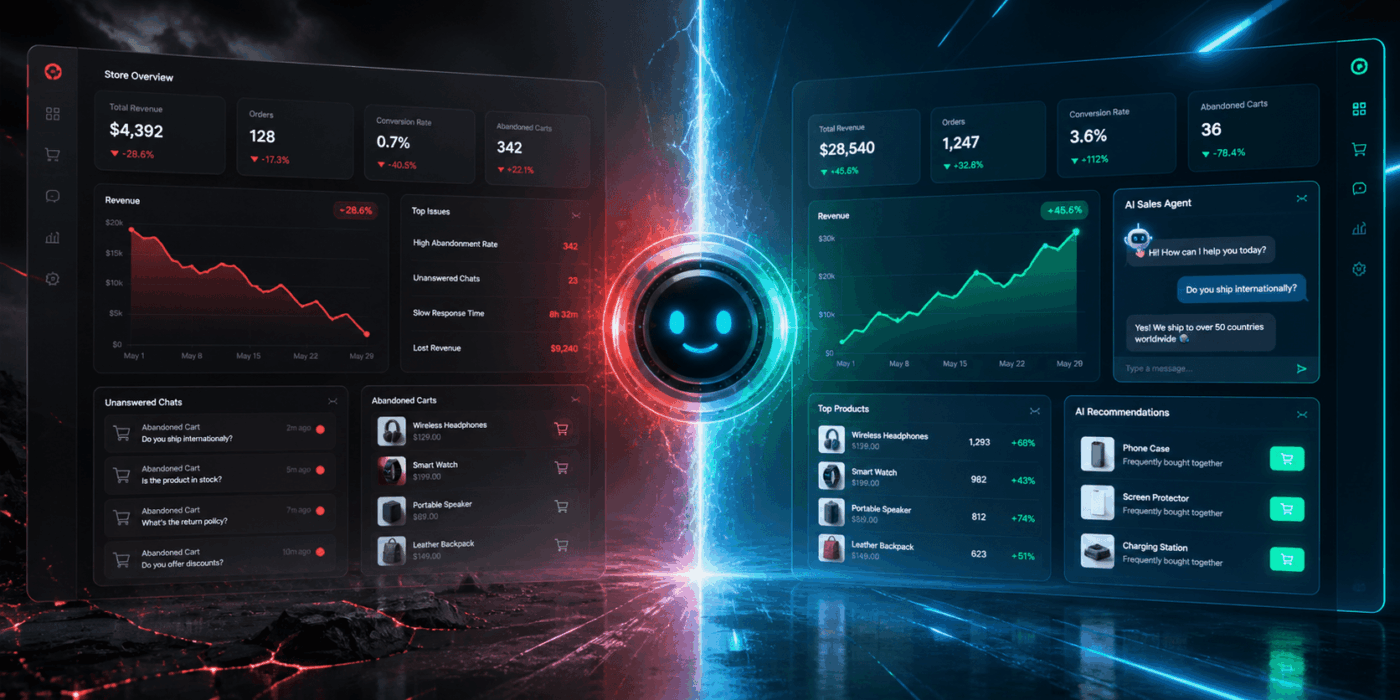
Understanding the measurable impact of behavioral AI on ecommerce revenue
Let’s talk practically.
How many people visit your store, hesitate, wonder if a product is right for them, and then simply leave?
How many of them would have bought if someone had answered them at the right moment?
Most ecommerce store owners ask the wrong question: “How much does it cost?”
The real question is: “How much revenue am I leaving on the table without an AI sales agent?”
The difference between these two questions determines whether you see AI as an expense or as a revenue investment. When you look at the real performance metrics of AI sales agents, it becomes clear why more online stores are starting to treat this technology as revenue infrastructure, not just another website add on.
The Revenue Gap Most Store Owners Do Not See
Most stores measure conversion optimization through completed purchases, abandoned carts, and checkout recovery.
But that creates a major blind spot.
These metrics mostly focus on customers who already showed strong buying intent. They chose a product. They added it to cart. They reached the final stages of the purchase journey.
But what about everyone who left before that?
These are the visitors who opened a product page, were not sure if it was right for them, did not find a clear answer, and left without taking the next step.
That is where a large part of the lost revenue sits.
According to Shopify benchmark data, average ecommerce conversion rates usually sit around 1 to 3 percent. That means the vast majority of visitors leave without buying.
And many of them do not abandon a cart.
They never reach the cart.
They leave during the consideration stage.
This is exactly where an AI sales agent can make a meaningful difference. It does not wait until the customer reaches checkout. It meets the customer during hesitation, answers questions, gives direction, explains the product, and helps move the customer closer to purchase.
If you run an online store and want to understand how an AI agent can change the rules of the game, it is worth looking at both the opportunities and the risks before you start.
What Happens in Real Online Stores?
This is not just about numbers on a dashboard. It is something store owners feel in their daily work.
I sell products with many details, sizes, compatibility questions, and repeated customer questions, and I was sure a bot would not be able to explain things properly.
After installing Tuki AI, I was surprised by the accuracy, the natural language, and especially by the fact that it asks the customer the right question instead of giving a generic answer.
During the first month, I saw fewer repetitive messages and more customers moving toward purchase without me needing to be available all the time.
I recommend it 🙂
This is the real difference between a regular chatbot and an AI sales agent.
A regular chatbot answers questions.
An AI sales agent understands what the customer is trying to buy, what is missing before they can decide, and which question should be asked next to move them forward.
Measuring the ROI of an AI Sales Agent
To understand the ROI of an AI sales agent, it is not enough to count how many chat messages were sent.
You need to measure what is actually connected to revenue.
1. Pre Cart Engagement Rate
How many visitors interacted with the AI before adding a product to cart?
This metric matters because it reveals hesitant customers who usually leave without leaving any clear signal behind.
2. Conversation to Purchase Conversion Rate
How many customers who received help from the AI continued to purchase?
This is one of the most important metrics because it connects the conversation directly to a business result.
3. Incremental Revenue
How much revenue came from customers who engaged with the AI, beyond what the store would likely have generated without it?
This is the metric that shows the real contribution of the system.
Tools like Tuki AI are built around this idea: not only answering customers, but helping store owners understand how conversations affect sales.
4. Increase in Average Order Value
When AI can suggest relevant complementary products in a smart way, it can help the customer build a better cart.
For example, a phone case with a screen protector, a 3D printer with the right filament, or a dress with a matching accessory.
The customer gets a better shopping experience, and the store increases the value of the order.
The Numbers You Should Actually Track
Instead of looking only at message volume or response time, focus on metrics that are directly connected to revenue:
- Conversion rate of customers who spoke with the AI compared to customers who did not
- Revenue per visitor who engaged with the AI
- Average order value with AI compared to without AI
- Reduction in repeated and low value support questions
- Number of conversations that led to product views or checkout
- Repeated customer questions that reveal problems in product pages
Some metrics may look impressive in a report but do not necessarily tell the business story:
- Total number of chat messages
- How many times the chat widget was opened
- How fast the bot replied
Response time matters, but it is not enough. The real question is whether the answer helped move the customer closer to buying.
A Simple Example of Lost Revenue
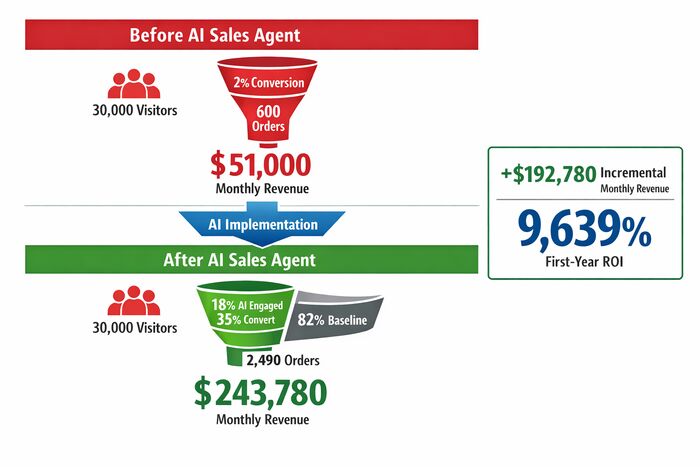
Let’s say an online store gets 30,000 visitors per month.
If the conversion rate is 2 percent, that means around 600 orders per month.
Now imagine that some of the visitors who did not buy were not irrelevant visitors. They simply did not get the answer they needed in time.
They wanted to know if the product was compatible, if there was a warranty, if the size was right, if shipping would arrive on time, or what the difference was between two similar products.
If an AI sales agent can recover even a small part of those hesitant visitors, the impact on revenue can be significant.
You do not need every visitor to buy. You only need a small percentage of hesitant visitors to get the right answer at the right moment.
That is exactly where an AI sales agent has an advantage. It does not wait for the customer to contact you on WhatsApp, it does not depend on business hours, and it does not miss customers who visit late at night.
Why Does This Work So Well in Ecommerce?
In ecommerce, many purchases fail not because of price, but because of uncertainty.
The customer does not always know:
- Which model is right for them
- Which size to choose
- What the difference is between similar products
- Whether the product is in stock
- How long shipping will take
- Whether there is a warranty
- What they should add to the order
When there is no clear answer, the customer leaves.
When there is a fast, clear, and reliable answer, the customer stays.
And when the answer also includes the right follow up question, the chance of purchase increases even more.
AI Sales Agent vs Regular Chatbot
One of the biggest mistakes store owners make is thinking that every bot is the same.
There is a big difference between a basic chatbot and an AI sales agent that is connected to the product catalog, store pages, and the business language of the brand.
Regular Chatbot
- Gives generic answers
- Sounds robotic
- Does not always understand customer intent
- Does not know how to move the customer forward
- Can give inaccurate answers
AI Sales Agent
- Understands the customer’s question
- Asks relevant follow up questions
- Uses information from the catalog and website
- Suggests suitable products
- Knows when to route the customer to a human
- Helps the customer move toward purchase
That is the difference between a system that answers and a system that sells.
The Benefits You Do Not Always See in the Sales Report
The ROI of an AI sales agent does not come only from direct orders.
There are additional benefits that build over time.
Less Pressure on the Team
When AI handles repetitive questions, the team can focus on complex sales, larger customers, marketing, and operations.
More Answers Outside Business Hours
Customers do not shop only during your working hours.
They visit your site in the evening, late at night, on weekends, and during holidays. If nobody answers them, some of them simply will not come back.
Better Product Pages
Customer conversations reveal what is not clear on the website.
If many customers ask the same question, it is a sign that the product page, images, description, or specification table should be improved.
More Confidence Before Purchase
A customer who gets a clear answer in real time feels that there is an active, professional, and available business behind the store.
That feeling directly affects the purchase decision.
Why AI Beats Static Conversion Optimization
Traditional conversion optimization focuses on changes such as buttons, headlines, colors, banners, and page layout.
These things matter, but they are static.
An AI sales agent works differently.
It responds in real time based on what the customer asks, which product they are viewing, what they are unsure about, and where they are in the buying journey.
Instead of showing every customer the same experience, it creates a personalized shopping experience.
That is exactly what a good salesperson does in a physical store.
The difference is that an AI agent does it on your website, 24 hours a day.
Does Every Store Need an AI Sales Agent?
Not every store needs the same level of AI.
But if your store has products with questions, compatibility, variations, sizes, specifications, warranties, shipping details, or complementary products, an AI sales agent can be highly valuable.
It is especially useful for stores that sell:
- Electronics and accessories
- Fashion and size based products
- Professional equipment
- Technology and hobby products
- Home and garden products
- Specialty food and products with ingredients
- Customizable products
- Expensive products that need explanation before purchase
The more confidence your customer needs before buying, the more valuable an AI agent becomes.
The Money You Are Losing Is Already Being Lost
Every day without an AI sales agent is a day where:
- Customers enter your store and do not get an answer
- Questions remain open
- Hesitant visitors leave before reaching the cart
- Your team wastes time on repeated questions
- Your competitors may close sales you missed
This is not a question of whether AI can help.
The real question is how long you are willing to let visitors leave without someone helping them buy.